The asking price on an Ascaya homesite tells you what the land costs. It doesn't tell you when the lot beside it will become a house, or whether it ever will. Ascaya sets no date by which a homesite owner must start or finish construction, and it puts no penalty on reselling an empty lot.
Here is what the rule means for a buyer. An Ascaya homesite can be bought, held and traded as land for as long as its owner likes. The developer doesn't set the pace of build-out. Hundreds of individual owners do. For anyone comparing Ascaya with other custom enclaves in the valley, the real variables are time and the neighbors' timing.
The rule, in Ascaya's own words
The community spells out its position plainly on its own FAQ page:
"Unlike many luxury communities, Ascaya imposes no homesite building timeline requirement and no resale penalties. Purchase when you're ready and build at your own pace."
The developer has said the same thing to the press. When the Las Vegas Review-Journal reported a new Ascaya land purchase on November 10, 2026, a spokesman for the developers confirmed there are no restrictions on reselling homesites in Ascaya.
Ascaya also lets owners use the full amenity package from the first day, before a foundation is poured. That includes the 23,000-square-foot Clubhouse, the 50-meter zero-edge pool, the tennis and pickleball pavilion, the two-acre Family Park and more than two miles of private trails. So an owner who holds a lot for years still gets the community's lifestyle during the wait.
What a lot becomes when nothing forces a build
The deals in the news this year show the rule at work. In March 2026 a single buyer bought four adjacent Cloud Rock homesites for $38.75 million. Ascaya called it the largest homesite purchase ever recorded in Las Vegas. The anchor lot, Homesite 256, covers 5.17 acres at about 3,055 feet of elevation and has a building envelope of roughly 77,966 square feet. The Review-Journal identified the buyer as Raiders owner Mark Davis. It reported that the four lots span about 19.2 acres, of which the development team put roughly 7.6 acres as buildable. Davis told the paper he would decide over time whether to build one project or as many as four, and that there was no rush.
Then, in October 2026, he added a 7.35-acre Ascaya parcel for $14.7 million. That brought him to six homesites bought for more than $59 million combined. The same Review-Journal report noted that property records show this parcel has changed hands several times over the past several years. It also observed that wealthy buyers in Southern Nevada sometimes buy a custom-home site, never build on it, and later sell the land.
Across the valley, the Summit Club in Summerlin shows how far that kind of holding can go. The Review-Journal reported in March 2026 that a vacant 1.8-acre homesite bought for $6.5 million in 2018 had sold the previous month for $18.15 million, nearly three times the purchase price. In March 2025, the paper reported the resale of another empty Summit Club parcel, 2.5 acres bought for $15.6 million in 2022, for $17.25 million in a sale that closed December 31. No building permits had been issued for the custom home planned there. These are Summerlin deals, and the Summit Club has its own rules. What they show is how top-tier valley land can trade as an asset in its own right, often without a house ever going up on it.
At Ascaya, the published policy leaves that door fully open.
The build-out runs on owners' clocks
When a developer sells a lot with a construction deadline, the build-out follows a schedule. Without one, the speed depends on each owner. Ascaya's own progress reports show what that looks like.
| Status | Early May 2025 | April 2026 |
|---|---|---|
| Completed homes | 67 | 92 |
| Under construction | 27, including permitting | 31 |
| In architectural review | 20 | 32 |
| Total in some stage | 114 | 155 |
Ascaya is planned for more than 300 homes. So as of April 2026, roughly half of the planned homes had not yet reached architectural review. Over those eleven months, 25 homes were finished, and the pipeline behind them grew from 47 to 63 homes in construction or review.
For a buyer, this is the practical part. Ascaya's minimum home size is 4,500 square feet on all but one street, and development lead Sam Brown told the Review-Journal in June 2025 that the community's average is probably above 8,000 square feet. Ascaya estimates 18 to 24 months from the start of construction to move-in. Any vacant lot near yours could stay empty for many years, or it could become an 8,000-square-foot construction site for two years starting next spring. The policy allows either one, and the decision belongs to someone you may never meet.
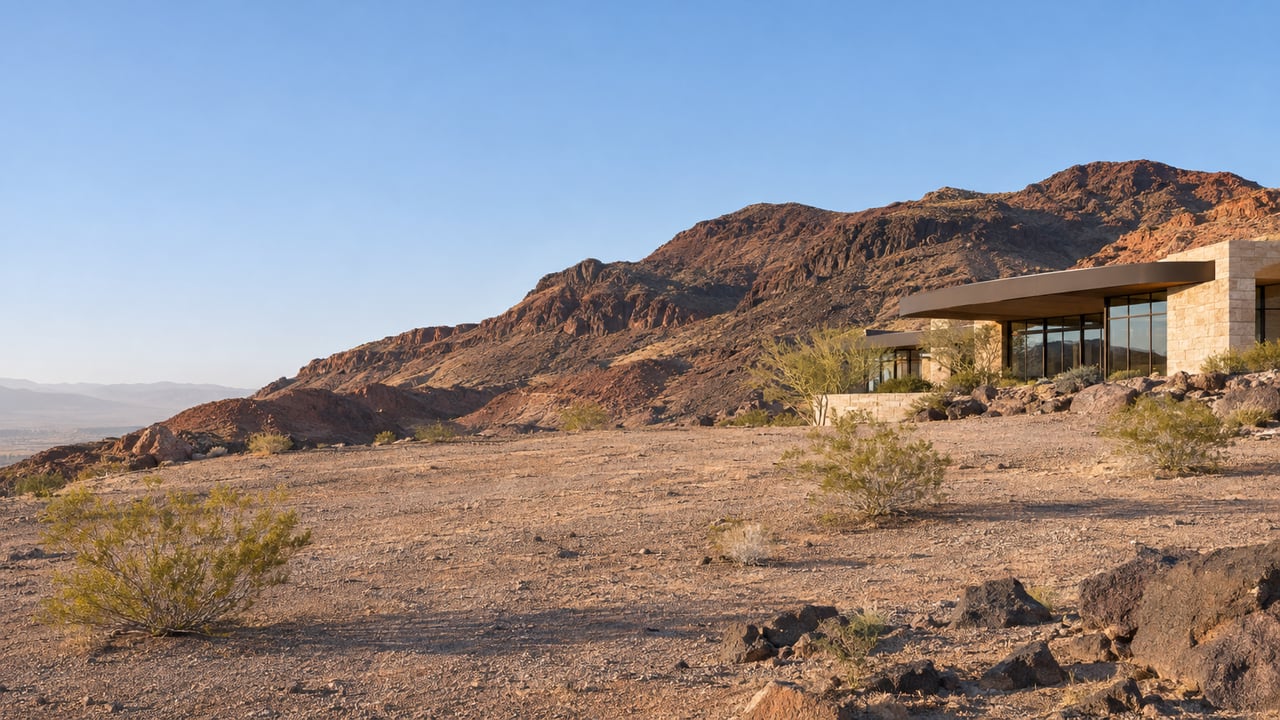
The ground itself explains why each project is a large one. Crews reportedly drilled, blasted and moved about 15 million cubic yards of material in the McCullough Range to build the community. Lots sit in terraces up a slope that rises nearly 1,000 feet above the valley floor.
Time is the price that isn't on the lot
The same rule that lets a neighbor wait also lets you wait. It does nothing to make the process faster once you decide to build. Ascaya's 18-to-24-month estimate only counts from construction commencement, and the community says the design phase varies with the project. In that June 2025 Review-Journal interview, Brown described the full sequence of hiring an architect, designing the house and building it as a two-to-three-year process.
That gap between buying the dirt and moving in is why Ascaya now sells three different products, each with a different relationship to time:
- A homesite. Estate homesites run from half an acre to more than two acres and are priced from $1 million. Ascaya released the Cloud Rock Collection, its final 58 developer-owned vacant homesites along the uppermost ridgelines, in June 2025. In its Q1 2026 update, Ascaya said a limited number of Cloud Rock sites remained, priced from $2 million. The featured lots on Ascaya's homesites page show asking prices from $1.599 million to $5.18 million. Expect two to three years before you move in.
- A Desert Design Study home. These are finished custom designs created with local design and construction firms and marketed for a much faster move-in than building from a homesite. One is listed on Ascaya's homes page at an asking price of $10.825 million. The design years are already done.
- The Canyon Residences. This is a collection of 51 single-level, lock-and-leave homes by Blue Heron across seven terraces, from 3,391 to 4,859 square feet, priced from $2.9 million. Terrace Four is complete, and it added six homes and the first of two wellness parks.
The price difference between a lot and a finished home covers construction, the two to three years of design and building, and the certainty of knowing exactly what you are buying. Ascaya reported $17.275 million in home sales and $40 million in homesite transactions in Q1 2026. Both markets are active, and they serve buyers working on very different timelines. If lock-and-leave appeals, our guide to lock-and-leave living options in Henderson puts the Canyon Residences in context alongside the rest of the city.
What to get in writing before an offer
The no-deadline policy turns several routine questions into important ones:
- The status of every adjacent lot. Ask whether each one has a finished home, a home under construction, an application in architectural review, or nothing at all. That tells you which neighbors' timelines are already in motion.
- The building envelope. Ascaya describes its premium sites by building envelope as well as acreage. The four-lot Cloud Rock assemblage covered about 19.2 acres but only around 7.6 buildable acres. Total acreage and usable acreage can be very different numbers on this terrain.
- Current association dues and the governing documents. Get the figures and the full rules from the association directly, rather than relying on older listing materials. Our overview of CC&Rs and HOA rules in Henderson explains which documents to request.
- Your own timeline, compared honestly. If you want to be in the house within a year, a homesite is the wrong product, however good the view.
This post is general information, not legal, tax or financial advice. Confirm how Ascaya's governing documents apply to a specific homesite with a real estate attorney or the appropriate professional before you commit.
FAQ
Does Ascaya require owners to build within a set number of years? No. Ascaya's FAQ says it imposes no homesite building timeline requirement and no resale penalties.
Can I use the Clubhouse before my home is built? Yes. Ascaya says all owners have full access to community amenities from day one, including during design and construction.
How far along is the community? As of April 2026, Ascaya reported 92 completed homes, 31 under construction and 32 in architectural review, against a plan for more than 300 homes.
When you're weighing an Ascaya homesite against a finished home or a Canyon Residence, The Prinsloo Group can help you compare the actual timelines, building envelopes and neighboring-lot activity side by side, drawing on years of developer-level experience with custom and vertical product across the valley. Start with our Ascaya community page, or Explore Properties & Request a Valuation if you're thinking about selling a lot or home there.